Why does Max Verstappen lead BoxBox's Belgian GP F1 Fantasy forecast after scoring -3 points at Silverstone? The short answer is upside, not certainty.
This is a dated pre-practice briefing based on the model run generated on July 9, 2026. It does not include current-weekend practice telemetry. For the newest phase, weather and lineup, use the live Belgian GP picks page.
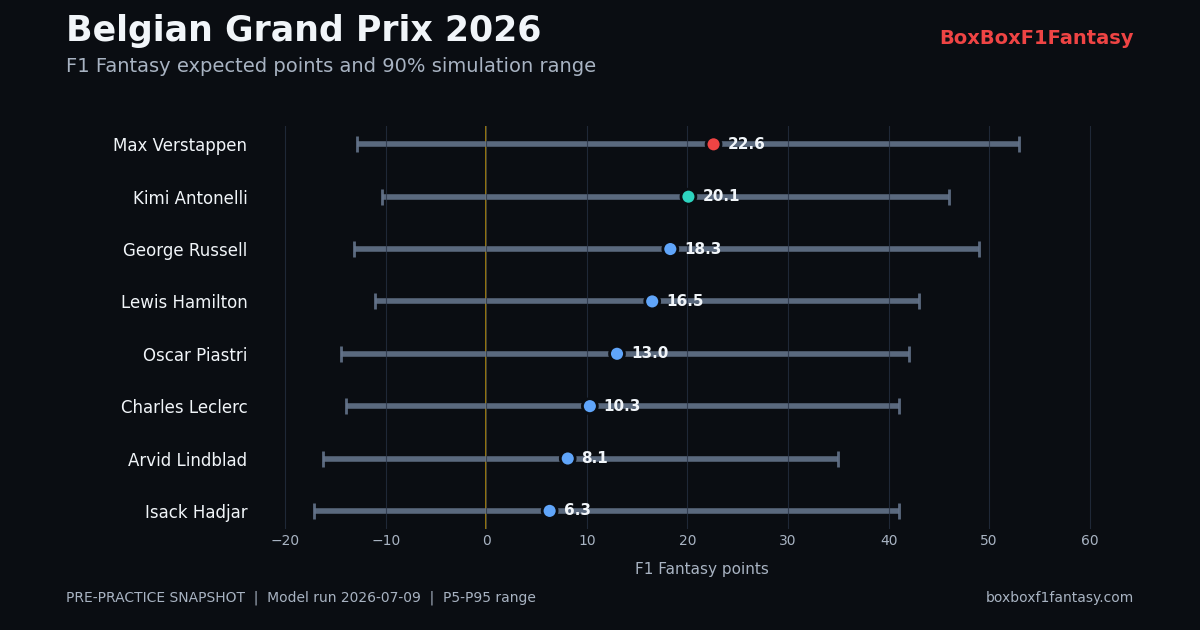
The short answer
Max leads the current risk-adjusted driver ranking at 22.6 expected points, narrowly ahead of Kimi Antonelli on 20.1 and George Russell on 18.3. The deterministic scenario is much more aggressive at 39.1 points. That gap matters: the model sees a route to a very large weekend, while the simulation also prices in the many ways a race can go wrong.
The visible forecast explains much of the upside. Max is predicted to qualify P3 and finish P1, which creates race-position points and two positions gained. He is also projected for eight overtakes, with a 15% fastest-lap probability and an 11% Driver of the Day probability. Those are valuable fantasy paths even if Red Bull is not the fastest constructor overall.
This is not a claim that Max is certain to win at Spa. His 90% simulation interval runs from -12.9 to 53.0 points, and his modeled DNF probability is 14%. The distribution is wide because his upside and downside are both real.
Why the Silverstone result does not erase the forecast
Max's recent form is a fair reason to question the ranking. BoxBox's completed-round history records 22 points in Spain, 43 in Austria and -3 at Silverstone, a three-round average of 20.7. The bad British GP is therefore present in the historical record rather than ignored.
One poor weekend is not the only input, though. The pre-practice forecast also considers longer-run driver and constructor form, reliability, circuit context and other priors available before the Belgian weekend. It then converts the predicted qualifying and race order into fantasy scoring opportunities. The model is effectively saying that Max's potential path from P3 to P1, plus overtakes and bonus chances, currently outweighs the recent negative result.
There is another useful reality check: Red Bull is not the top constructor projection. Mercedes leads at 54.8 expected points, Ferrari follows at 41.0 and Red Bull is third at 40.2. That distinction supports the user's concern about the car. The model can rate Max as the highest-upside individual driver without claiming Red Bull is the strongest two-car fantasy package.
Why skepticism is still reasonable
Four reasons argue against treating Max as an automatic pick:
- The current forecast is pre-practice, so no Belgian FP pace is included.
- The P5 downside is negative at -12.9 points.
- A 14% DNF probability is meaningful when a premium driver costs $27.9M.
- The deterministic 39.1-point scenario is far above the 22.6 risk-adjusted mean, showing how much uncertainty sits around the central upside case.
That is why the Max Verstappen profile shows both figures and the full confidence range. A single headline projection would hide the most important part of the decision.
The strongest alternatives
Kimi Antonelli
Antonelli is second at 20.1 expected points and $25.4M. His modeled DNF probability is only 8%, lower than Max's, and his P5 floor of -10.4 is the strongest among the current driver field. He is predicted to qualify P1 and finish P3. The model gives up some ceiling relative to Max but buys a slightly better downside profile.
Kimi's latest three recorded fantasy scores are -4, 35 and 23, an 18.0-point average. That is not as strong as Russell's recent run, but the current race-specific model still places Kimi ahead.
George Russell
Russell is third at 18.3 expected points and $27.8M, with a P2 qualifying and P2 finish forecast. His recent history is excellent: 28, 35 and 44 points over the last three completed rounds, averaging 35.7. Anyone prioritising observed form over the current race projection has a legitimate reason to prefer him.
Russell's 90% range is -13.2 to 49.0, however, and his modeled DNF probability is also 14%. Strong recent scoring does not remove race-week variance.
Lewis Hamilton
Hamilton is fourth at 16.5 expected points and $24.5M. His 6% DNF probability is one of the more attractive premium-driver risk figures, while the model predicts P4 in both qualifying and the race. He offers less positions-gained upside than Max but a more conservative reliability profile.
The value pick that changes the build
Arvid Lindblad leads the driver value table at 1.31 expected points per million. He costs $6.2M and projects for 8.1 points, with a P11 to P10 finish path. His latest three completed-round scores are 10, 6 and 18, an 11.3-point average.
Lindblad does not need to outscore the premium drivers to be useful. His job in a lineup is to return enough value to fund stronger constructors or a boosted premium pick. That is why raw points and PPM should always be read together.
The current optimized Balanced lineup also uses Gabriel Bortoleto and Nico Hulkenberg as low-cost enablers. Hulkenberg carries a negative expected score, so this is not an endorsement of him in isolation. It is the consequence of evaluating the complete seven-asset roster under a $100M cap.
Constructor picture
The current constructor order tells a different story from the driver ranking:
- Mercedes: 54.8 expected points, $31.7M, 1.73 PPM, P5 floor 4.5.
- Ferrari: 41.0 expected points, $25.7M, 1.60 PPM, P5 floor 0.6.
- Red Bull: 40.2 expected points, $30.0M, 1.34 PPM, P5 floor -10.3.
- McLaren: 29.0 expected points, $30.1M, 0.96 PPM, P5 floor -8.5.
- Racing Bulls: 21.0 expected points, $11.1M, a field-leading 1.89 PPM, P5 floor -11.1.
Mercedes has the strongest expected total and downside floor. Racing Bulls is the value lever. Ferrari currently edges Red Bull despite costing $4.3M less, which is another reason not to read Max's driver rank as a blanket endorsement of every Red Bull asset.
Current optimized team snapshot
Using the live optimizer's default Balanced basis and a normal 2x boost, the crawlable snapshot is:
- Max Verstappen, 2x boost
- Isack Hadjar
- Arvid Lindblad
- Gabriel Bortoleto
- Nico Hulkenberg
- Mercedes
- Racing Bulls
The team costs $98.6M, leaves $1.4M in the bank and projects for 169.3 Balanced points with the boost. Balanced averages the deterministic projection and risk-adjusted simulation mean. It is designed to preserve upside without letting one optimistic scenario dominate the roster.
This snapshot is a starting point, not a command. Use the Lineup Optimizer with your real budget, locks, exclusions and chip choice. Use Team Compare if you are deciding between Max, Kimi or Russell builds.
Weather is moving faster than the model
The weather feed was updated on July 12, later than the July 9 prediction run. It currently shows the highest rain probability in FP2 at 71%, qualifying at 42% and the race at 22%.
The published fantasy ranges used an earlier medium-risk weather snapshot. The newer forecast has not yet been applied to the points above. That distinction is important: a fresh weather widget does not automatically make an older model run fresh.
If practice is wet, unrepresentative or heavily interrupted, the post-practice update may remain unusually uncertain. If the sessions are representative, current-weekend pace should be the most important new evidence for deciding whether Max's upside case survives.
What should change after practice?
After FP1, FP2 and FP3, watch four things:
- Repeatable qualifying pace: not just one fastest lap, but whether Max, Mercedes and Ferrari can repeat competitive laps.
- Long-run evidence: useful for race confidence, even though practice fuel loads remain unknown.
- Reliability and session completion: missed running can widen uncertainty rather than clarify it.
- Weather alignment: the model should be rerun against the latest forecast instead of relying on the July 9 snapshot.
If Red Bull looks clearly third-fastest in representative practice and Max lacks a strong one-lap or long-run signal, his predicted P3-to-P1 path should face pressure. If he remains near the front and shows repeatable pace, the high fantasy ranking will be easier to defend.
Bottom line
Max is first because the current model sees the largest combination of finishing-position upside, positions gained, overtakes and bonus probability. He is not first because the site assumes Red Bull is the fastest constructor, and the wide confidence range is a warning against reading 22.6 as certainty.
The honest pre-practice decision is therefore conditional: Max is the leading upside candidate, Kimi offers the strongest current downside floor, Russell has the best recent premium-driver form, and Lindblad is the clearest value enabler. Recheck the Belgian GP race-week page after practice before committing transfers or a chip.